
The coffee grinder is the most consequential piece of equipment in any specialty coffee setup, and its burr set is the single component that determines what happens to the coffee before water ever touches it. Every extraction variable, from flow rate to flavour clarity to channelling risk, is downstream of the particle size distribution the grinder produces. Two grinders set to the same nominal grind size can produce dramatically different espresso because their burr geometries generate fundamentally different particle populations, and no amount of dose or pressure adjustment can fully compensate for a poorly matched distribution.
This article examines the geometry of conical and flat burr sets, the particle size distributions each produces, the mechanisms by which those distributions affect extraction, and the specific argument for unimodal distribution profiles in light roast single-origin espresso. It is written for baristas and home enthusiasts who want to understand grinding as an engineering problem rather than a dial position.
1. Burr Geometry: The Cutting Mechanism
Burr grinders reduce coffee beans by fracturing them between two abrasive surfaces, one stationary and one rotating, separated by a gap whose width determines the nominal particle size. The two dominant geometries in specialty grinding are the conical burr, in which a cone-shaped inner burr rotates within a matching outer ring, and the flat burr, in which two parallel discs with radial cutting teeth face each other. Both designs achieve particle reduction through the same basic mechanism of shear fracture, but the geometry of their cutting surfaces produces profoundly different outcomes.
In a conical burr set, the gap between the burrs changes continuously along the burr axis. Beans enter at the top, where the gap is widest, and are progressively reduced as they descend toward the narrowest part of the cutting zone. This creates a gradual reduction profile in which particles pass through multiple sequential cutting stages before exiting. Flat burrs, by contrast, present a constant gap across the entire cutting surface. Particles are reduced in a single pass across a uniform cutting zone, with the particle size determined primarily by the gap width and the tooth geometry of the burr faces.
Figure 3.1 (Illustrative): Particle Size Distribution, Conical vs Flat Burr at Equal Nominal Setting
Illustrative: the shapes show the general pattern described in the text, not measured distributions. Orange Line: flat burr, a narrower peak. Dashed Dark Line: conical burr, a broader spread with a fines tail. Test your own grinder with a sieve or laser diffraction to confirm the pattern.
2. Fines, Boulders, and the Extraction Problem
Every grinding process produces a distribution of particle sizes rather than a single uniform size, and the shape of that distribution determines extraction behaviour. Particles that are significantly smaller than the nominal size are called fines, typically defined as particles below 100 micrometres. Particles significantly larger than nominal are called boulders. Both populations create extraction problems, through different mechanisms.
Fines extract rapidly and completely because their high surface-area-to-volume ratio gives water immediate access to soluble compounds. Their rapid extraction contributes disproportionately to the bitterness and astringency of the final cup, as the bitter compounds that dissolve most readily from fine particles are extracted before the desirable compounds in the larger particles have reached their optimal yield. Fines also migrate through the puck during extraction, accumulating in the lower layers and filling interstitial spaces, which increases puck resistance and creates the density heterogeneity that drives channelling.
Boulders extract slowly and incompletely. A boulder fragment may not release its desirable flavour compounds within the standard extraction time, leaving them locked in the coffee grounds. The consequence is a cup that tastes sour, thin, and underdeveloped, a classic symptom of under-extraction that cannot be corrected by simply grinding finer, because finer grinding increases the fines population and brings its own bitterness and channelling problems.
2.1 The Case for Unimodal Distribution
The ideal particle size distribution for espresso is unimodal, meaning a single sharp peak with minimal tails in either direction. A unimodal distribution ensures that the majority of particles extract at similar rates, producing a uniform extraction yield across the coffee bed. Every particle reaches its optimal extraction point at roughly the same time, so the final cup reflects the balanced expression of the coffee's soluble compounds rather than a mixture of over-extracted fines and under-extracted boulders.
Flat burrs are often reported to produce a more unimodal distribution than conical burrs at equivalent nominal settings, because the constant gap and single-pass cutting geometry generate more consistent particle reduction. This is why flat burr grinders have become the preferred tool for light roast single-origin espresso in many specialty roasteries, where the clarity and transparency of the cup depend critically on eliminating the bitter fines population that conical geometries tend to generate.
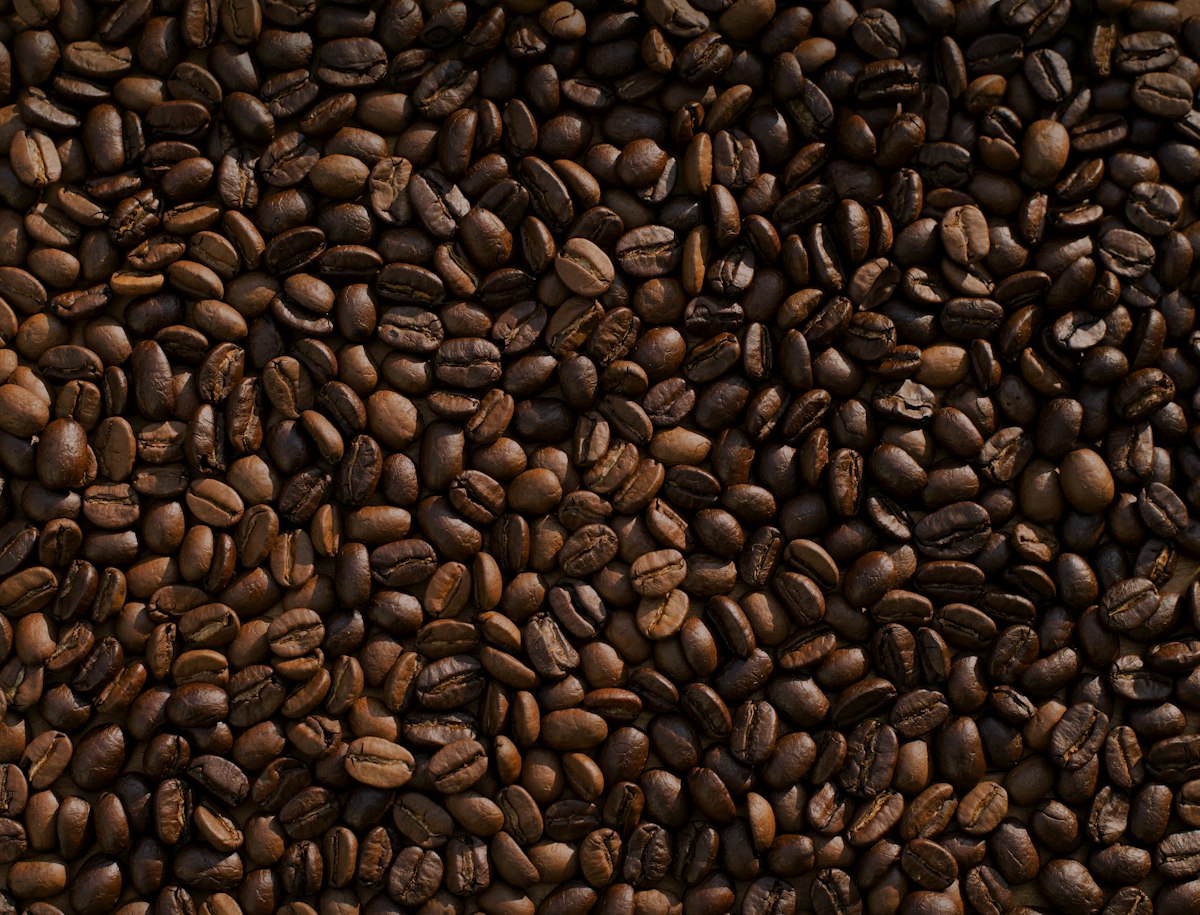
Freshly ground coffee particles under magnification reveal the distribution of sizes produced by the burr set. Uniform particle size is the foundation of uniform extraction.
3. Light Roast Hardness and Fracture Behaviour
Light roast coffee beans are denser and harder than their darker counterparts, because roasting progressively expands the cellular structure and reduces bean density. This is why light roast beans are generally denser to grind than dark roast beans. This density difference has direct consequences for grinding: harder beans require more energy to fracture, generate more heat in the grinding zone, and fracture along different planes that produce a different particle shape distribution.
The higher hardness of light roast beans means that burr wear and burr geometry matter more than they do for dark roasts. A burr set that is worn or poorly aligned may produce acceptable distributions with dark roast coffee but generate unacceptable fines populations with light roast. Flat burrs with sharp, well-maintained teeth are more forgiving of light roast hardness because their single-pass cutting geometry applies consistent force across the bean surface, while conical burrs with their multi-stage reduction may accumulate fines in the early cutting stages as harder beans resist initial fracture.
Figure 3.2 (Illustrative): Fines Percentage vs Burr Wear Over Time, Light Roast Espresso
Illustrative: a general wear pattern, not measured data. Orange Line: flat burr. Dashed Dark Line: conical burr. Track your own fines percentage with a sieve or laser test and decide on replacement from that, not from a fixed number.
4. Burr Alignment, Maintenance, and Consistency
Burr geometry only delivers its theoretical performance when the burr set is correctly aligned and maintained. Misalignment, where the two burr faces are not perfectly parallel or concentric, produces variable gap width across the cutting surface, generating a bimodal distribution with simultaneous fines and boulders even when the nominal setting is correct. Alignment should be verified after every burr replacement and checked periodically through a simple paper test or by examining grind distribution patterns on a sieve.
Burr wear is inevitable and progressive. As burr teeth dull, cutting efficiency decreases, bean fracture becomes less clean, and fines production rises. The rate of wear depends on the hardness of the coffee being ground, with light roasts accelerating wear compared to darker roasts, and on the grinding volume. Replacement intervals depend on the grinder, the coffee and the volume ground, so they are best set by periodic particle distribution testing and manufacturer guidance rather than a fixed weight.
The final consistency argument is that grind distribution is a time-varying variable. A grinder that produces an ideal unimodal distribution when new will gradually drift toward a broader distribution as burrs wear, changing extraction behaviour without any change to the dial setting. Regular distribution monitoring, using either laser diffraction equipment or a simple sieve stack, is the only reliable way to detect this drift and maintain the consistency that light roast single-origin espresso demands.